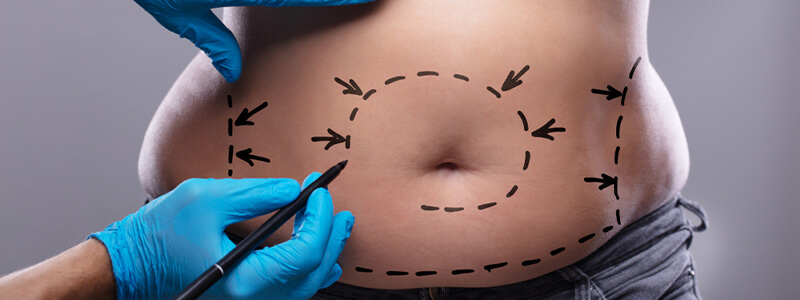
In liposuction surgery, the stubborn fat area is first inflated with a special liquid (tumescent) injection. Then, several incisions of a few mm length are made on or near this area. From these incisions, metal pipes called “cannula” with a diameter of 2-6 mm, connected to the vacuum device, are inserted into the subcutaneous layer, depending on the patient’s condition. Excess fat begins to be removed by moving the cannulas at the appropriate depth in the fat accumulation areas hardened with the tumescent solution, breaking up and sucking with the grating logic. The process of absorbing the fats by means of vacuum continues until the desired body contour as well as a smooth skin surface is achieved. This method, which is completely based on dexterity and arm strength, is called conventional (classic) liposuction. Today, power-assisted liposuction technique, in which the cannula vibrates automatically with the help of a device, has also been used in order to facilitate and speed up the process. In recent years, ultrasound (Vaser liposuction) and laser (Laser liposuction) energies have also been used. In these methods, excess fat tissues are broken up with ultrasound waves or laser beams, and then they are removed by vacuum in a similar way. Compared to the conventional (classical) method, these two methods have lower complication rates such as pain, bleeding, tissue damage, and fluctuation, while the skin tightens better after surgery. In these methods, excess fat tissues are broken up with ultrasound waves or laser beams, and then they are removed by vacuum in a similar way. Compared to the conventional (classical) method, these two methods have lower complication rates such as pain, bleeding, tissue damage, and fluctuation, while the skin tightens better after surgery. In these methods, excess fat tissues are broken up with ultrasound waves or laser beams, and then they are removed by vacuum in a similar way. Compared to the conventional (classical) method, these two methods have lower complication rates such as pain, bleeding, tissue damage, and fluctuation, while the skin tightens better after surgery.
With liposuction, stubborn excess fat in the deep layers is removed, but with the method called superficial liposuction or “liposculpture” developed in recent years, fat accumulations that cause contour irregularity can also be removed. Liposculpture technique has also become a method that gives good results in removing skin sagging and eliminating stubborn cellulite.
Liposuction has taken its indispensable place in body contour correction today. As long as the aim is contour correction, not weakening, it is an extremely safe and low-risk operation in well-chosen patients, with well-applied techniques in hospital conditions, if the safety limit is not exceeded. Today, the safety limit is accepted as 2.5-4.5 liters in different sources. However, it is also possible to take a larger amount of fat in selected patients. In this case, measures are taken to complete the patient’s fluid and electrolyte balance, and sometimes a blood transfusion may be necessary.


 English
 English